
Friday, June 19, 2009

Richmond Summer Night Market

It was an unseasonably warm spring day in Vancouver, and a pesky mosquito had snuck into my cousin Emily's house and had begun to circle me, moving in for the kill (and I'm not just being overly dramatic here - I have 'skeeter syndrome' so this was a serious situation). Emily came to my rescue with what looked like a tennis racket except that it shot electrical sparks and electrocuted my tiny assailant upon contact!

"Where the heck do you buy something like that?!" I exclaimed. "Oh, the Asian night market", she replied laughingly. Obsessed with getting my own mosquito taser, I planned to visit the night market before I left Vancouver. But of course I didn't make it there that year, and pretty much forgot about it during subsequent visits to Vancouver. Recently, one of my friends mentioned that the major draw of the night market was the FOOD (oink, did someone just say the magic word?!). So finally, on our most recent trip to Vancouver, this little piggy went to market (the Asian night market, that is)!

There are actually two Asian night markets in the Vancouver area, the
Vancouver Chinatown Night Market (100 vendors) and the Richmond Summer Night Market (300 hundred vendors). Both are modeled after open air night markets found throughout Asia. In the last few years, the Richmond Summer Night Market has become one of the biggest attractions in Canada, featuring an 'international' food fair and live entertainment, attracting thousands of visitors every weekend from mid-May till the beginning of October. (note: prior to 2008, the night market was run by a different event promoter who lost his lease to the property. Since then he's filed a lawsuit against the current promoter for "hijacking" the event that he founded. Source: Asian Pacific Post)

Hubby Kris and I arrived at the night market around 11pm on a Saturday night. We headed straight for the action (food stalls), bypassing the lonely vendors hawking Asian knicknacks, cell phone accessories, and cheap clothing.

Granny panties, anyone?

How 'bout a giant tiger scroll?


OK, on to the food. Everything's cheap ($1- $5). CASH ONLY!

Grilled meat on a stick:


Curried fish balls:


Yum!

Fresh coconut drinks:

Takoyaki (doughballs filled with octopus, topped with Japanese condiments):


Dim sum:


Waffles were a popular item, at least 1/2 dozen stalls were offering some kind of waffle variation.

Egg balls (tiny sweet waffle balls, Kris loves these):

Fish shaped chocolate and red-bean waffles (aka
taiyaki):


Taiwanese wheel cakes/sugar coated strawberries on a stick:


Korean waffles:


Dragon's beard candy:


Bubble Tea:


"Love" Crepes:


Gourmet desserts:


Southeast Asian desserts (or what I call 'everything but the kitchen sink' desserts):


Deep fried marshmallow pockets:


And no, I never did find the mosquito taser :(
(I got distracted by the food, can you blame me?)


Richmond Summer Night Market
http://www.summernightmarket.com
12631 Vulcan Way (behind Home Depot on Sweden Way)
Richmond, BC, Canada
Open May 15 - Oct 4, 2009
Every Fri and Sat 7pm - 12am, Sun till 11pm
Long Weekends Sun 7pm - 12am, Mon till 11pm



Share/Save/Bookmark

Wednesday, June 17, 2009

Weird Food Wednesdays: Dragon's Beard Candy


During our trip to Vancouver last month, Kris and I visited the Richmond Summer Night Market, where we gorged ourselves on Asian street food (stay tuned, that's a whole 'nother post!) And that's also where I found the 'regal' dragon's beard candy, originally made for the emperors of China. The dragon is a Chinese imperial symbol and the long white strands of spun sugar resemble a beard, hence the name 'dragon's beard'.

The ancient art of making dragon's beard candy has been passed down from master to apprentice, and only a few hundred people in the world today know how to properly make it. Sugar, corn syrup/maltose, and water are boiled down to the soft-crack candy stage, left to cool and then pulled to form thousands of silky strands. Glutinous rice flour is used to keep the strands separated during the pulling process (watch detailed video of this secret art on youtube,
Part 1 and Part 2). The strands are sectioned into manageable sized pieces and wrapped around chopped roasted peanuts, sesame seeds, and shredded coconut:


After all this work, $3 for 6 pieces seemed like a bargain!


They're also fun to eat -the outside melts away in your mouth like cotton candy, leaving you with the crunch from the yummy nuts and seeds. Not earth-shattering, but I'm glad I got to try it.


Dragon's beard candy is difficult to find, not only because there are few 'masters' left who know how to make it, but also due to its non-existent shelf life. Freshly made candy are best enjoyed immediately (like cotton candy), or else they will shrivel up into mummified goobers (trying to save some for later will undoubtedly turn into a sticky science experiment).

But for all you weird food fanatics out there, Bamboo Garden has found a way to keep their "
Icy-Crispy Dragon Beard Candy" fresh for up to six months from the date of manufacture. But be prepared to pay $2 per piece plus shipping!

Or you might have some luck finding dragon's beard candy in your local Chinatown or Asian supermarkets. I'll post an update if I ever come across it again.


Have you ever tried dragon's beard candy? Or know where to get it? Please leave me a comment!


Share/Save/Bookmark

Monday, June 15, 2009

Fine Dining(?) at Citi Field

Hi everyone, it’s Kris!

Phyllis recently blogged about my
fine dining experience at Yankee Stadium, so I thought it was only fair to do a post on Citi Field.
I was invited by my friend John to last Thursday’s game (6/11/09 Mets vs Phillies) and our Delta club seats gave us access to the
Acela Club, a 350 seat ‘fine dining’ restaurant overlooking left field.

So what's a diehard Yankees fan doing at a Mets game? Come on guys, you should all know me by now - I never turn down free seats to anything!

Me, John, and Bernie in the 10th row: Some exciting footage of the game:


The view of the field from the Acela Club restaurant: Inside the restaurant:
At dinnertime, a $48 prix fixe menu gives you unlimited access to the market table buffet (soup, salad, antipasto, cured meats, and hot pasta stations) and a choice of one entrƩe (jumbo crab cakes, prime rib, roasted pork etc).

Market table buffet: White cheddar mac n cheese with pancetta, baked garganelli with short rib bolognese, Tribeca caesar salad with white anchovies:
Jumbo lump crab cakes with tomato, caper and cauliflower chutney:
Grilled skirt steak, salsa verde, sweet potato fries:
So how did this compare to dining at Yankee Stadium? While my crab cakes and buffet selections were all delicious, it wasn't exactly 'fine dining'. And I'd have to say that I was more impressed with the gourmet spread at the Yankee Legends Suite which featured waygu beef, lamb cheeks, ramp risotto, and fiddlehead ferns. The Yankees buffet had more variety and hot cooking stations and was included with the cost of the Legend club seats. And the Mets Acela Club didn't offer any dessert (at least not that night).

Sorry Mets fans, but I'd have to give the win of this fine dining 'subway series' to Yankee Stadium!


And for all you Howard Stern fans out there, look who I ran into at the game: Hard to miss him with everyone yelling out "Baba Booey!"


Share/Save/Bookmark

Friday, June 12, 2009

For the Love of Fish: From Producer to Plate


Most of you know that I was in Vancouver (stuffing my face) last month, and over the next few weeks I will be sharing some of my favorite and most memorable experiences from my trip.

On Thursday, May 28th, hubby Kris and I attended "For The Love of Fish: From Producer to Plate", a guided tasting of eight local sustainable seafoods prepared by local chefs, hosted by Slow Food Vancouver and SeaChoice at the Italian Cultural Centre in Vancouver.

The star line-up included world renowned chef
Hidekazu Tojo, famous for inventing the California roll, Chef Robert Clark of C Restaurant, local champion of sustainable seafood, and Chef Andrea Carlson, executive chef of Bishop's Restaurant, a Vancouver institution featuring award-winning regional cuisine.

Featured producers and fishermen, including my spot prawn buddy
Steve Johansen from Organic Ocean, were there to showcase their sustainable seafood and answer questions. Only 100 seats were available for $50 per ticket ($35 for Slow Food members), a bargain price to taste the seafood creations of local celebrity chefs (and a lot cheaper than fine dining at Tojo's, Bishop's, or C Restaurant).


I know most of you are probably here to gawk at the food, but I've also thrown in some sustainable seafood facts and interesting tidbits I learned from attending this 3 hour event.

The tasting was accompanied by a bread basket from the Bread Affair, artisanal cheeses from Mt. Pleasant Cheese Company, and wine from Farmstead Wines:


ALBACORE TUNA, spice encrusted and lightly seared, chilled and served with smoked salt, Pemberton beet salad, and horseradish dressing (from Natural Gift Seafoods, as prepared by Chef Peter Berg, and plated by Chef Quang Dang of C Restaurant):
BC albacore tuna is not only sustainable (trolling results in very little by-catch), it's deliciously rich and buttery, and so highly regarded that most of the commerical catch is shipped to Japan as sashimi grade tuna.


PACIFIC SARDINES, lightly seared and pickled, pumpernickel bread, sour cream, cilantro and cucumber (from Seaside Marketing, as prepared by Chef Colman Herrington, A Plus Catering): Sardines are very nutritious, rich in omega-3 fatty acids, and low in mercury and other contaminants. They
disappeared completely from British Columbia waters in the 1940s and mysteriously reappeared 50 years later in the early 1990s. Overcooking oily fish like sardines will result in fishiness!


SABLEFISH COLLAR aka SABLEENE, marinated in sweet vermouth, served with edamame daikon salad (from Seaside Marketing, as prepared by Chef Clement Chan, Mosaic Restaurant, Hyatt Regency Vancouver):

Sablefish is also known as black cod. Before sableenes became fashionable, they were thrown overboard by fisherman or ground into fishmeal for fertilizer! Sustainable seafood is all about using every part of the fish, and these tasty little morsels are starting to pop up on local menus.


KUSSHI OYSTER, shallot wine mignonette, brunoise of organic apples with cider vinegar (from Stellar Bay Shellfish, as prepared by Chef Matthew Davies, Provence Marinaside Grill): Off-bottom oyster farms have little impact on the environment. This clean tasting
kuushi was also Kris' first raw oyster! And he liked it!


COHO SALMON, marinated in brown sugar, with watercress salad (from Swift Aquaculture, as prepared by Chef Robert Clark, C Restaurant):

Most Atlantic salmon is farmed using open-net pens in the ocean, a method known for it's devastating impact on wild salmon populations. Swift Aquaculture's coho salmon is farmed in an environmentally responsible closed tank system, and it's really delicious too!


DUNGENESS CRAB, fried crispy dungeness crab avocado roll (from Seafood 4 Life, as prepared by Chef Hidekazu Tojo from Tojo’s Restaurant):


DUNGENESS CRAB, raw scallop, raw salmon, wrapped in egg crepe, topped with roe: Unique to the Westcoast, sweet Dungeness crabs are caught using baited traps, resulting in low by-catch. I have to admit that I get starstruck easily, so I was most excited to try these sushi rolls prepared by the famous Hidekazu Tojo! And they were absolutely delicious. Raw fish novice Kris was on a roll that night (pun intended), eating raw salmon, scallop, spot prawn, and oyster! YAY Kris!


SPOT PRAWNS, on kombu with pea shoot salad and tomato jelly (from Organic Ocean, as prepared by Chef Julian Bond, Pacific Institute of Culinary Arts):

Named for the 4 distinctive white spots on their shells, sustainable wild BC spot prawns are highly prized for their sweetness and firm textured flesh. But you already knew that if you've read my recent post about Vancouver's Annual Spot Prawn Festival and my interview with producer Steve Johansen.


PACIFIC SCALLOPS, cured with fennel, salt and sugar, citrus brine, with sweet sicily pod, shaved fennel and rhubarb (from Edge Water Foods, as prepared by Chef Andrea Carlson, Bishop’s Restaurant):

My favorite dish of the night, scallop was super sweet and juicy! Off-bottom farming of BC scallops doesn't hurt the sea floor like dredging (on-bottom farming).


Do you love fish and seafood? Are you worried about our oceans? You can make a difference by choosing sustainable seafoods:
USA - Monterey Bay Aquarium Seafood Watch for all US Regions

Canada's Seafood Guide


Share/Save/Bookmark

Wednesday, June 10, 2009

Weird Food Wednesdays: Mangosteen

Mangosteen, the queen of all fruit!

Isn't it pretty?

The number of petals on the bottom will indicate how many segments of the fruit are inside.


Before April '08, I'd never even heard of
mangosteen before (rather embarassing, given that I'm from Southeast Asia, where the majority of the fruit are grown). I had my first taste of fresh mangosteen in Singapore last year, at the StraightsKitchen buffet in the Grand Hyatt hotel. The mangosteens were so popular that hubby Kris and I were lucky to grab even one before they all disappeared from the buffet.

The flavor of mangosteen is rather unique, almost indescribable, but fans have likened the flavor to a cross between strawberry, peach, kiwi, and plum; sweet with a little bit of sour. The texture reminds me of the inside of a grape, slightly slimy but firm, comparable to
lychee or longan. My cousin Anne-Marie argues that the texture is more like the interior of a plum and she swears that the flavor's been different every time she's tried it.


Fresh mangosteen from Southeast Asia were not available (at least not legally) in the US until two years ago, when the
USDA lifted a ban on importation, allowing Thai mangosteens on to US soil as long as they were treated with irradiation (to kill any foreign pests) before export. Not sure how irradiation affects the mangosteen's flavor or the reputed health benefits from the xanthones. What I do know is that mangosteens are still pretty rare in the US, and not being able to have them makes me want them even more.

Three weeks ago, while shopping at
T&T Supermarket in Vancouver (actually, more like 'browsing' since I was on vacation - doesn't everyone visit local supermarkets for fun while on vacation?), I noticed several women huddled around a pile of strange looking fruit.

What is that? Some kind of exotic purple potato? When I got close enough to see the sign for Thai mangosteens at $3.99/lb, my disbelief quickly turned into euphoria. I dove into the middle of the crowd and bagged at least 3 pounds of mangosteens before realizing that I didn't know how to tell whether they were ripe or not. I stopped stuffing my bag momentarily to observe the mangosteen picking prowess of my fellow shoppers. A friendly Asian woman advised me to choose the dark purple ones that have a slight give when you press the outer shell. I reluctantly put back the gorgeous (but unripe) magenta specimens and replaced them with the darkest ones I could find in the pile.
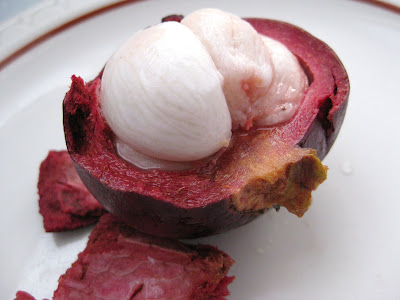
Back at home, I dug my fingernail into a soft exterior spot on a purplish brown mangosteen, and slowly began peeling away the thick red pericarp, exposing the milky white segmented flesh.

You're actually supposed to use a knife to score a line around the circumference so the peel comes off in two clean pieces. This method will result in most attractive display of the fruit within, but I'm far too clumsy to do that without cutting myself (flashback to a bagel slicing incident).

After I dug out the fattest segment, I bit into it anxiously, expecting to taste heaven, only to experience disappointment. It wasn't as good as I remembered. My own fault, really, I should have known better - imported fruit will never taste as good as indigenous fruit (so this is why my cousin Anne-Marie will only eat mangosteens in Malaysia). And you can't even blame irradiation, Canada is not subject to the same importation laws as the US. This mangosteen, while sweet and tangy, was definitely slimier and had a slight metallic aftertaste. Kris, however, couldn't get enough of these imported mangosteens, he swears the flavor and texture were exactly the same as what we'd eaten in Singapore. Not trying to knock my hubby or anything, but I still consider him a novice when it comes to exotic fruit. I was glad that I only spent $3.99 a pound on them at T&T!

So what did I do with the rest of the mangosteen? I handed one out to each of my bewildered friends. Definitely a conversation starter.

WHERE TO BUY:

I think most of the hype comes from the novelty of this rare fruit, you certainly don't come across mangosteens very often in the US. But in my opinion, it's so NOT worth the $25-$40 per lb being charged at high-end specialty markets. Your best bet is to head to your local Chinatown, and look for the fruit carts that appear on the streets during the summer months (mangosteen season starts as early as April, lasting till August or September). You may also be lucky enough to find them fresh or frozen at your local Asian food market.

I'm also keeping updated on cheap mangosteen sightings in NYC
here.

Don't have a Chinatown or Asian market nearby and desperate to have mangosteen? Here are some places you can get fresh mangosteen at ridiculous prices:

Online:
Melissa's ($42.30 + shipping for 2.5 lbs)
Importfood.com ($43.65 + shipping for 2 lbs)
1-800 Organic Fruit of the Month Club (if you are just looking to satisfy your curiousity, you can buy just one mangosteen from here for $9.99 + shipping)
24 Hour Best Buy ($29.99 + shipping for 6 mangosteens)

NYC Specialty Markets:
Agata & Valentina (from Puerto Rico, starting in August)
Dean & Deluca (Thai mangosteens available occasionally during summer months, call first)

National Supermarkets (supplied by
Melissa's, not available at all locations, call first):
Wegmans
Kroger
Harris Teeter

Other ways to enjoy mangosteen:
freeze-dried mangosteen at
Trader Joe's ($2.99 for 1.5 oz)
mangosteen juice
mangosteen perfume
artificial mangosteen for display purposes


Share/Save/Bookmark

Wednesday, June 3, 2009

Weird Food Wednesdays: Crickets

I've been wanting to try crickets ever since I watched Salma Hayek chow down on cricket tacos on Ellen a couple years ago.

And I finally got my chance last week at Vij's in Vancouver! Vij's cricket bread appetizer is #28 on Vancouver Magazine's Eat This: 101 things to taste before you die (and while in Vancouver, Hubby Kris and I managed to cross off at least a dozen items on this list without even trying - stay tuned for more later...)

Vij's spicy ground cricket parantha with tomato-onion chutney and celeriac salad:
Looks pretty harmless, right? But it's 70% ground cricket! And very filling too - crickets are a great source of protein (and I'm all for alternative sustainable protein sources). Tasted pretty good too - slightly nutty, like a multigrain flatbread. But the flavor was so mild I really couldn't tell there were bugs in it.

The observant staff at Vij's noticed our enthusiasm about the bread and asked whether we'd like to try the crickets on their own? Yes, please! A few minutes later, 4 roasted crickets arrived at our table. And they tasted exactly like the bread - mild and a bit nutty. "Just like pumpkin seeds!", declared owner Vikram Vij when he stopped by the table to say hello.


So where does one get enough crickets to make that much bread every night? "Near Abbotsford, BC, just across the US border, from a pet store", replied Vij. Awwww, poor little guys, I'd forgotten that people keep crickets as pets! "Don't worry," assured Vij, "we freeze them before cooking them, it's more humane that way." I guess the cold makes them sleepy like their crustacean cousins. And just in case you were wondering, crickets are the same as shellfish when it comes to food allergies.

Can't make it to Vancouver to try Vij's cricket bread? Make it at home - Vikram Vij shared his parantha recipe with the Globe & Mail recently. Or become friends with Salma Hayek, and maybe she'll bring you some crickets as a hostess gift. And for those with a sweet tooth, the ever popular Cricket Lick It!

Interestingly enough, I'm not the only blogger eating crickets this week - check out Eileen's insect dinner at Typhoon restaurant at Eileen Likes To Eat and Eating Vancouver 09 - food insanity pt 2 - The Church of Vij's at EAT. DRINK. LIVE.


Now go eat some insects already!


06/08/09 update:
After getting a couple of reader requests about where to buy crickets, I called Fluker Farms
to ask whether their live bulk crickets are suitable for human consumption. They responded, "No, we do not recommend them for human consumption because they are not raised for that purpose. However, they have been used before on shows like Fear Factor."

So the search continues...


Share/Save/Bookmark